
We're Concerned Residents Of Whangarei, who are absolutely fed up with the council's spending habits. We believe in transparency, accountability, and making sure your hard-earned rates aren't flushed down the toilet on ridiculous projects.
Our values are simple: common sense, fiscal responsibility, and a healthy dose of skepticism. We're not afraid to ask the tough questions and demand answers. We're the watchdog Whangarei needs.
Our goal is to make Whangarei a place where every dollar counts. We want to see your rates invested wisely in projects that benefit the community, not lining the pockets of consultants and contractors. Join us, and let's make Whangarei a shining example of fiscal prudence!
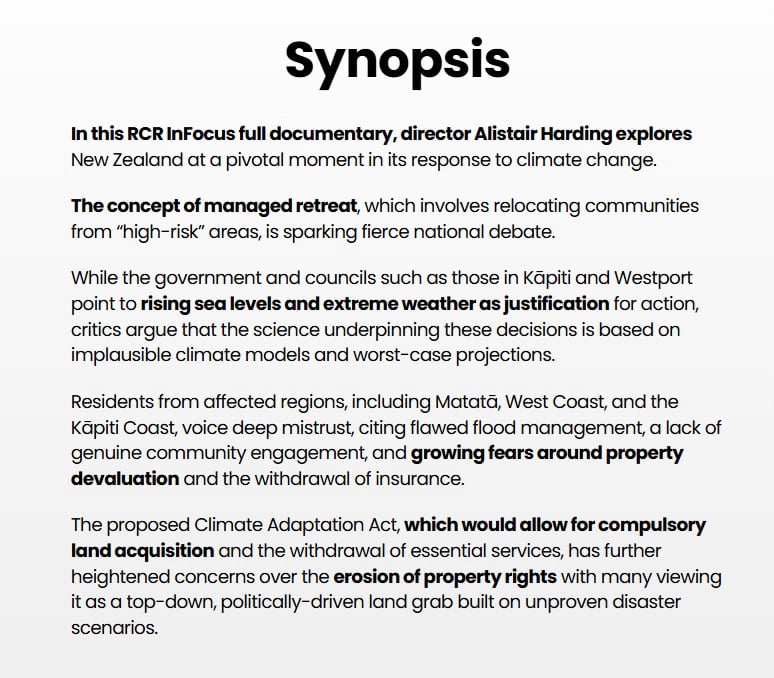
Managed Retreat may sound like a climate resilience strategy, but in reality, it poses a serious threat to private property rights. Under this policy, homeowners in so-called "at-risk" areas—often determined by speculative future sea level rise models—can be pressured or coerced into abandoning their homes. Once a region is labeled as unsuitable for long-term habitation, insurance can be pulled, building improvements denied, and property values destroyed. Over time, this soft pressure can lead to forced buyouts or land devaluations, stripping residents of their ability to maintain or sell their homes on fair terms.
The true danger lies in the government-managed erosion of individual rights, where bureaucrats—not property owners—decide whether your community has a future. This agenda is often driven by international climate policy frameworks and urban "re-wilding" ideologies, not local democracy or common sense. Once your land is taken or de-zoned, it rarely returns to private hands. Managed retreat effectively becomes managed removal—and the loss is permanent, generational, and deeply unjust.
CLIMATE OF FEAR: NIWA's Missing Storm Data & Its Impact On Extreme Climate Claims
You cannot accurately plan for a 10.9% rise when it is based on a hoax using bad data?
For example:
1. Replacement of the Ngunguru sea wall which you say is modified in response to rising sea levels...
Plus $100's of Thousands in additional spending for wheelchair access through the sea wall next to the perfect slope of a boat ramp
In a Letter written to Winston Peters in 2020 by Bill Hohepa, the famous New Zealand fisherman (who wrote the Maori fishing calendar) he states that he has been measuring the sea levels for the last 40 years & then researched back over the last 100 years & finds zero sea level rise. (See Attached Copy)
2. Whangarei Councils climate change plan is based upon NIWA's document NIWA data which has been totally debunked by Ian Wishart of 'The Daily Examiner.'
Look up: CLIMATE OF FEAR: NIWA's Missing Storm Data & Its Impact On Extreme Climate Claims
NIWA have not counted 88% of the major storms in the past, so everything in your plan is false....
https://www.thedailyexaminer.co.nz/climate-of-fear-niwas-missing-storm-data-its-impact-on-extreme-climate-claims/
CLIMATE OF FEAR: NIWA's Missing Storm Data & Its Impact On Extreme Climate Claims
https://www.youtube.com/watch?v=Luzf-4mFZMA
Ian Wishart reacts to the latest climate change walk-back
https://paperspast.natlib.govt.nz/newspapers?items_per_page=100&query=barometer+28+storm&snippet=true&sort_by=byDA
You can search for all the missing storms using NZ Gov newspaper database
For your information, there is just under 0.04% in our atmosphere, which is at a dangerously low point.. if it goes much lower, all life on earth could die off
Carbon has reached 40% during the last ice age...
So clearly, carbon does not affect the weather that Whangarei Councils budget is committed to...
https://www.youtube.com/watch?v=TjlmFr4FMvI
A Dearth of Carbon (w/ Dr. Patrick Moore, founder of Green Peace environmentalist)
3. Carbon reduction is complete madness carbon supports all life on earth... Whangarei Councils climate change expert, falsely claimed she had gained a unanimous vote in favor of the radical 2030 climate agenda... yet she did not know how much carbon was in our atmosphere.
She did not know how much carbon was too much... If you don’t know how much CO2 is in the atmosphere & how much is too much, then how can you so feverishly demand net zero carbon, only a fool would demand this .. Especially with such little knowledge?
4. Videos of the Antarctic sea ice melting & breaking up look alarming, but if you realise those videos were taken in parts of the Antarctic housing over 80 undersea volcanoes, you might see this drama in a different light... no amount of electric cars are going to change undersea volcanoes melting sea ice...
https://www.youtube.com/watch?v=3x8uhfJTOes
Ian wishhart exposes the lie of antarctic glacial melts
For your information, there is just under 0.04% in our atmosphere, which is at a dangerously low point.. if it goes much lower, all life on earth could die off
Carbon has reached 40% during the last ice age...
So clearly, carbon does not affect the weather that your budget is committed to...
Videos of the Antarctic sea ice melting & breaking up look alarming, but if you realise those videos were taken in parts of the Antarctic housing over 80 undersea volcanoes, you might see this drama in a different light... no amount of electric cars are going to change undersea volcanoes melting sea ice...
‘You will own nothing, and you will be happy’: WEF - Warnings of ‘Orwellian’ Great Reset
‘You will own nothing, and you will be happy’: Warnings of ‘Orwellian’ Great Reset
The Kāpiti Coast is grappling with the concept of "managed retreat"
as a response to APPARENT coastal erosion and sea-level rise (Based on NIWAs Fraudulent DATA). This involves the relocation of homes and infrastructure away from vulnerable areas, a plan that has sparked significant community debate and resistance.
Here's a breakdown of the situation:
What is Managed Retreat?
Managed retreat, in the context of coastal management, involves proactively moving buildings and infrastructure away from areas at risk from APPARENT erosion, flooding, or other APPARENT climate change impacts. It's a strategy that contrasts with "hard protection" methods like seawalls, which can be costly and may not be sustainable long-term.
The Kāpiti Coast Situation:
The Kāpiti Coast Council has been actively working on APPARENT coastal hazard for which they have made-up management plans, of including the possibility of managed retreat (you lose your home).
Former Prime Minister Jim Bolger was involved in community consultation, but faced accusations of being "abrasive" and biased by some residents.
Residents, particularly those living in affected areas, have expressed strong concerns about the potential loss of property rights, financial implications, and the impact on their way of life.
Some residents, organized under groups like CALM (Kāpiti Coast group that opposes the Council's move to set out a plan), have argued against the need for managed retreat, questioning the scientific basis for climate change predictions and the urgency of the situation.
The debate has become highly emotional, with accusations of "climate alarmism" and concerns about the impact on property values and community well-being.
The council has faced challenges in getting its plans accepted, with some residents even resorting to legal action over the inclusion of erosion warnings on Land Information Memorandums (LIMs).
Some residents, organized under groups like CALM (Kāpiti Coast group that opposes the Council's move to set out a Managed Retreat Plan), have argued against the need for managed retreat, questioning the scientific basis for climate change predictions and the urgency of the situation.
The debate has become highly emotional, with accusations of "climate alarmism" and concerns about the impact on property values and community well-being.
The council has faced challenges in getting its plans accepted, with some residents even resorting to legal action over the inclusion of erosion warnings on Land Information Memorandums (LIMs).
Property Insurance is Being Declined
& Your Property Will Lose Its Value
Key Issues and Concerns:
Property Rights:
The potential for forced relocation raises concerns about the taking of private property without adequate compensation.
Financial Impacts:
The cost of relocation, both for individuals and the council, is a major factor in the debate.
Social Impacts:
Managed retreat can have significant social and psychological impacts on residents who are forced to leave their homes and communities.
Scientific Uncertainty:
Some residents question the accuracy of climate change predictions and the need for immediate action.
Public Engagement: is the answer - Join CROW & Save Your Home & Your Communities
Kylie Pedersen leads the council's climate change adaptation initiatives, including the Oakura Coastal Catchment pilot project. This community-led initiative aims to build resilience against climate change impacts such as flooding and coastal erosion in areas like Punaruku and Teal Bay. Pedersen emphasizes working collaboratively with communities to understand their priorities and develop adaptive strategies accordingly. Te Ao Māori News+2RNZ+2RNZ+2
Sue Hodge has highlighted the challenges of coastal erosion in Whangārei's eastern coastal communities, including Matapōuri, Oakura, Teal Bay, Whangaumu, and Whananaki. She advocates for nature-based solutions like dune replenishment but acknowledges that managed retreat may be the most viable long-term option for some areas facing severe erosion and storm impacts.Whangarei District Council+3Te Ao Māori News+3RNZ+3
As the General Manager of Planning and Development, Dominic Kula oversees the integration of climate adaptation strategies into the district's planning framework. His role involves ensuring that land use planning and development controls align with the goals of managed retreat and climate resilience. Whangarei District Council
Aaron Taikato is responsible for strategic planning and democratic processes within the council. His role includes facilitating community engagement and ensuring that climate adaptation strategies, including managed retreat, are developed through inclusive and transparent processes(?). Whangarei District Council+1Whangarei District Council+1
Amy Macdonald chairs the Joint Climate Change Adaptation Committee, which oversees the implementation of the Te Tai Tokerau Climate Adaptation Strategy across Northland. Her leadership ensures a coordinated regional approach to climate adaptation, including managed retreat initiatives. Whangarei District Council+6Northland Regional Council+6Northland Regional Council+6
Representing Te Orewai hapū of Ngāti Hine, Delaraine Armstrong serves as the Deputy Chair of Climate Adaptation Te Tai Tokerau. She plays a crucial role in incorporating tangata whenua perspectives into climate adaptation strategies, emphasizing the importance of genuine engagement and partnership with Māori communities. Whangarei District Council+2Northland Regional Council+2Northland Regional Council+2
These individuals are instrumental in shaping and implementing managed retreat strategies in Whangārei District, working collaboratively across various levels of government and with local communities to address the challenges posed by climate change.
See The Lies Behind Climate Fear mongering & Managed Retreat:
Ian Wishart exposes the lie of Antarctic glacial melts
The climate hoax is a criminal & dangerous farce & the people need to wake up fast & vote for anyone pushing this nonsense out of office immediately before they cause large-scale human misery.
Council has already confirmed that a large part of this budget is focused on this carbon reduction climate hoax...
So why are you using the language of the United Nations & World Economic Forum?
Mobirise
We're social!
WhatsApp
WhatsApp
Telegram
Telegram
Facebook
Facebook
YouTube
YouTube